
Free workshop
Free workshop
Article Contents
A positive and appreciative team environment is essential for successful collaboration and productivity. One of the best ways to achieve this is by recognizing and celebrating individual strengths.
However, facilitating group work can be challenging to keep everyone engaged and simultaneously building relationships within the group i.e. psychological safety. To help you with this challenge, this blog post will explore how the method “The Strengths I See in You” and the use of coaching cards can be a great tool to inspire your participants to become aware, share and appreciate their strong traits.
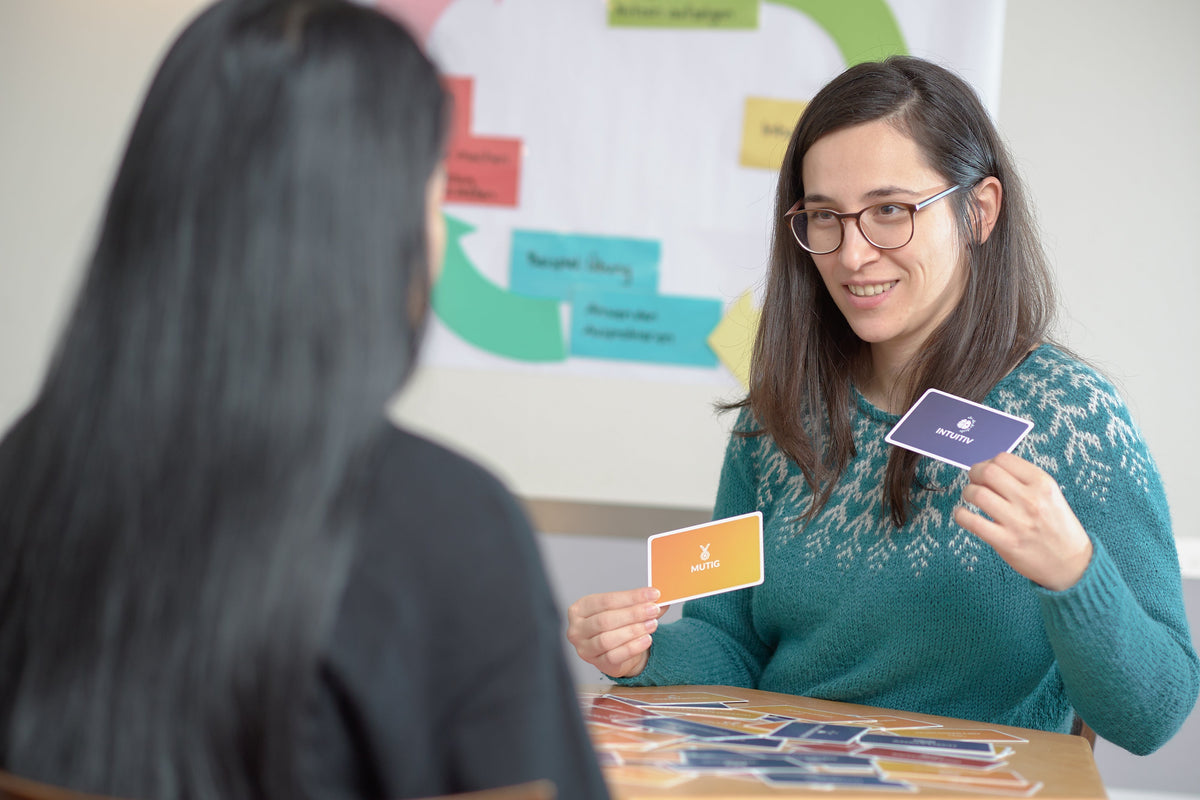
Strengths cards can be used in various contexts, such as team development programs, retreats, or retrospectives. This activity creates opportunities for team members to connect, appreciate each other's strengths, and initiate valuable feedback conversations.
By facilitating engaging activities like this, you can provide an opportunity for team members to connect, recognize each other's abilities, and build a stronger sense of teamwork which leads to better productivity and success.
Onsite
Virtual
Timing is crucial. This is why we estimate it for you! For the following descriptive steps you have to allocate timing alongside this. Make sure to follow the timing and always tell your participants up front how much time they have for each step. This helps to manage expectations and get the best possible results.
Divide the group in sub-groups of 3-5 people with their own card set each to work with. This ensures that there are sufficient cards available for all participants to choose from.
With a group of 5 people, you will use 5 x 4 = 20 cards out of the set of 52. This leaves sufficient choice for all participants of the exercise. Including more participants is possible, but at the risk of people not “finding the card they are looking for”.
Depending on your intention you may group people randomly, by a shared interest or by how much they already know each other. Place people in the same sub-group who you want to develop strong relationships with each other.
Tips:
This step will help reveal positive thoughts about each other that may have gone unnoticed. Lay out the cards on a table or the ground and display the pictures side of the cards in front of the group.
Variation: You may opt to use the card side that shows the strength words in which case people will work more from a cognitive than an emotional perspective. Words speak to our minds while images speak to our hearts. It depends on your participants what will work best for them.
Ask everyone to reflect on their collaboration with the other participants. Use guide questions to help find the right images in the individual reflection as you ask everyone to choose an image for every other person.
Here are some open-ended guide questions that you can use:
"What strengths do you see in your team mates?" “How do you perceive each other's strengths in this group?” "What strengths that you admire do you see in your teammates?” “What are the hidden strengths within this group that could be use more effectively?” “What are the unique strengths within this group that contribute to a positive and collaborative team culture?”
You see that the example questions put different emphasis on either individual strengths or group strengths. Use a wording and focus that goes best with your intention of the exercise.
Provide a sufficient amount of time for selecting and reflecting on their cards.
A step-by-step video guide on how to recognize individual strengths in a team.
Once all cards have been distributed, let people go back to their chairs and give them some time to reflect. Encourage everyone to write on the back of the card which strength they connect to the image. What did the other person want to tell by handing over that particular image? Writing it down makes it easy to connect self image and public image in the next step.
In the subgroups each participant first shares what they she/he thinks about the cards and what they believe the intention behind the particular card was. After that the person that actually gave the card can reveal what their real intent was and which strength they connected the image to. You can further guide the conversation by digging deeper with questions like “Which behavior do you connect this strength to?”, “How does she express that strength?” or “How does this strength contribute to the success of our team?”. Invite the participants to write down what they hear on the back of the cards, too. Now they have their own interpretation and the interpretation of the team.
Tips:
Get all sub-groups back together in the full group and debrief the exercise by going through the different debriefing phases using guiding questions. Of course debriefing is not working in a purely linear logic.
These 4 stages are indicative how we move from discussing the direct experience, to abstracting it and lastly relating it to future intent and changing behavior:
Strengths lie in creating an environment that promotes appreciation, feedback, and self-awareness within a team or group. By utilizing strengths cards and facilitating engaging activities, you help create an environment where team members can connect, appreciate each other's strengths, and initiate feedback conversations.
Ready to enhance your team facilitation? Visit metaFox.eu today to explore our different card sets and discover the endless possibilities for team development and collaboration.

