

Therapy Tools
Tools support mental health professionals in helping clients explore emotions, strengths, values, build insight, and communicate with more ease.
Visual prompts, reflective worksheets, and structured exercises offer gentle ways for clients to express what feels complex or hard to name, while strengthening safety and connection in individual, couples, family, or group sessions.
Flexible across therapeutic orientations, the tools reduce cognitive load, open space for deeper reflection, and help clients notice patterns, navigate transitions, and articulate their inner experience at a pace that feels right for them. 💖
-
The Feelings Wheel - tool for emotional intelligence and reflection
Prix d'origine £12.00 - Prix d'origine £12.00Prix d'origine£12.00£12.00 - £12.00Prix actuel £12.00The Feelings Wheel is a visual tool that helps you and your clients name and understand emotions. With 72 feelings organized around six core emotio...
Afficher tous les détails


What people say

I use it right now in almost every consultation, one woman was really impressed how she picked the adequate cards that reflected her resources that she had forgotten during a stressful situation. I also used it in a Resilience Workshop with teachers from a secondary school in Bonn and they worked really well as inspiration for group work! Likewise, I give the set to my clients and let them pick the cards they like - also this simple intervention always creates new ideas and mostly, the revival of old resources!
Dr. Antje Lumma-Sellenthin
Psychologist and Systemic Therapist
I primarily used the card set in my work with clients whose focus is often strongly on deficits. The clients were asked to select cards with strengths they already possess and lay them out in front of them.
Subsequently, further cards were selected that represent strengths they would like to develop or expand (goal setting).
By laying out the cards, the large number of existing positive strengths was literally made visible. This led to an immediate increase in self-efficacy and a shift in focus away from problems and towards problem-solving skills.
In conclusion, the strengths card set is an excellent tool for experiential, strengths-based work in occupational therapy. It promotes self-reflection, boosts self-esteem, and is a wonderful starting point for motivational work and goal-oriented action planning. A clear recommendation for all therapists who want to work in a resource-oriented way.
Saskia Schuster
Occupational Therapist

I had used the "World of Emotions" cards in one of my events - "Authenticity Unmasked" - A Valentine’s Day Special on 14 Feb 2025. I love using the pictures cards to facilitate my group sessions for the participants to share by asking them, "Choose an image that represents you." and "What is one image that describes the most authentic version of you?"
The cards encouraged the participants to explore and reflect about their authentic selves.
Vincent Soo
Integrative Psychotherapeutic Coach


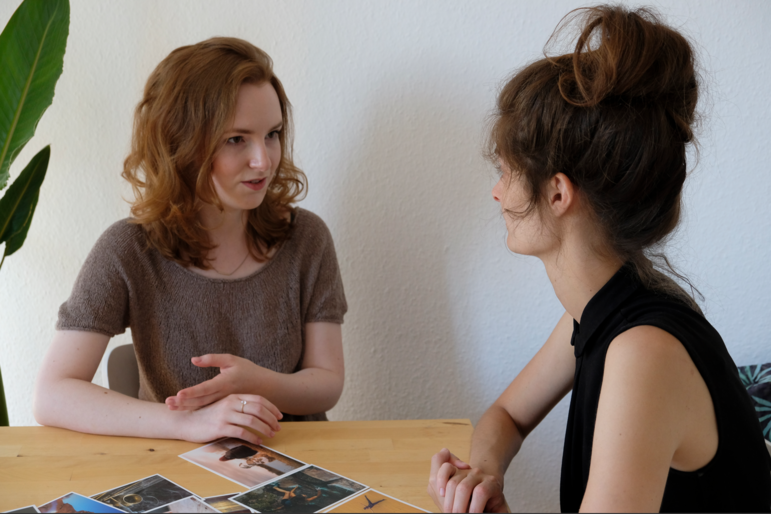
How to weave these tools into your therapeutic style
- Introduce a card or visual prompt to ground clients before going into deeper topics
- Invite clients to choose an image or statement that resonates and explore what it evokes
- Use reflective worksheets to help structure complex themes like boundaries, relationships, or internal conflicts
- Allow clients to engage with tools at their own pace; the process can be as gentle or as exploratory as they need
- In groups, use conversation prompts to set the tone, encourage inclusion, and build trust
The goal isn’t to “do an activity” but to create openings, deepen the therapeutic alliance, and offer clarity where words may be hard to find.

